
How Forensics Signature Examination Helps Identify Altered, Simulated and Disguised Signatures
A signature can be only a few strokes of ink, yet it can carry significant legal, financial and personal importance.
Signatures are used to authorize contracts, approve transactions, execute agreements, verify documents, endorse cheques and establish identity. When a signature is questioned, the issue is rarely limited to whether it “looks genuine.”
The real forensic question is:
Was the questioned signature actually written by the person whose name it represents?
Answering that question requires systematic examination rather than visual assumptions.
Forensics signature analysis is a specialized area of questioned document examination that evaluates handwriting characteristics, writing habits, line quality, pen movement, proportions, spacing, connections and other observable features to determine whether a questioned signature is consistent with known genuine writing.
For organizations, financial institutions, legal teams and individuals in Bangalore, Karnataka and across India, professional signature examination can be particularly valuable when a disputed document has financial, contractual, employment or legal consequences.
This guide explains how forensic experts examine questioned signatures, the different forms of signature forgery, what evidence is required, and why professional forensic examination matters.
What Is Forensics Signature Analysis?
Forensics signature analysis is the scientific examination and comparison of a questioned signature with authenticated reference signatures. It forms part of forensics document examination, a discipline concerned with determining the authenticity, authorship and alteration of questioned documents.
An examiner may evaluate characteristics such as:
- Line quality
- Stroke formation
- Pen movement
- Writing speed and fluency
- Letter formation
- Slant
- Proportion
- Spacing
- Baseline alignment
- Connecting strokes
- Pen lifts
- Tremors
- Initial and terminal strokes
- Relative size of components
- Natural variation
The examination does not depend on finding one identical feature.
Instead, forensic experts assess the overall pattern of writing characteristics and determine whether the questioned signature is consistent with the known writing of the purported writer.
Why Signature Forensics Matters
A disputed signature can affect matters involving substantial financial or legal consequences.
Forensic signature examination may be required in cases involving:
- Property transactions
- Sale agreements
- Loan and banking documents
- Cheques
- Wills and testamentary documents
- Power of attorney documents
- Business contracts
- Employment documents
- Insurance claims
- Financial fraud
- Corporate disputes
- Identity-related fraud
- Legal and civil disputes
A signature may appear convincing to an untrained observer while containing characteristics that require closer forensic examination.
Conversely, natural variation can make genuine signatures look different from one another.
This is why simply comparing two signatures visually is not the same as conducting a forensics signature examination.
What Makes a Signature Difficult to Authenticate?
Human handwriting is naturally variable.
The same person may produce signatures that differ depending on:
- Writing position
- Writing surface
- Pen type
- Time pressure
- Physical condition
- Emotional state
- Writing speed
- Available space
- Purpose of the signature
Therefore, forensic examination must distinguish between natural variation and characteristics that may indicate simulation, tracing or other forms of forgery. The availability and quality of comparison material also influence the examination.
Common Types of Signature Forgery
Understanding how signatures can be forged helps explain why forensic examination requires more than visual comparison.
Simulated Signature Forgery
A simulated signature is produced by attempting to imitate another person's genuine signature.
The forger may repeatedly study an authentic signature and attempt to reproduce its appearance.
During forensics examination, an expert may look for characteristics associated with unnatural execution, such as:
- Hesitation
- Slow movement
- Tremor
- Poor line quality
- Unusual pen lifts
- Inconsistent proportions
- Disconnected strokes
The presence of an individual characteristic alone does not establish forgery. It must be considered in the overall examination.
Traced Signature
A traced signature may be created by following the outline or visible form of an authentic signature.
Depending on the method used, examination may consider:
- Stroke quality
- Tremor
- Line continuity
- Pen movement
- Indications of hesitation
- Evidence associated with the tracing process
The original document and examination conditions are important when assessing such evidence.
Disguised Signature
A person may intentionally alter their own writing characteristics to make a signature appear different. This can occur in certain fraudulent or deceptive situations. The examiner may therefore consider whether apparent differences fall within natural variation or whether there are characteristics suggesting deliberate alteration.
Freehand Imitation
A person may attempt to reproduce a signature from memory or by visually studying a sample without tracing it. Such signatures may reproduce the broad appearance while failing to reproduce the natural writing dynamics of the original writer.
How Do Forensic Experts Examine a Questioned Signature?
A professional signature forgery investigation follows a structured process.
1. Case Assessment
The examination begins by understanding the nature of the dispute.
The examiner considers:
- What document is questioned?
- Which signature is disputed?
- Who is alleged to have written it?
- When was the document created?
- What genuine signatures are available?
- What questions must the examination answer?
The investigation scope should be established before comparison begins.
2. Examination of the Questioned Document
The questioned document is examined carefully under suitable conditions.
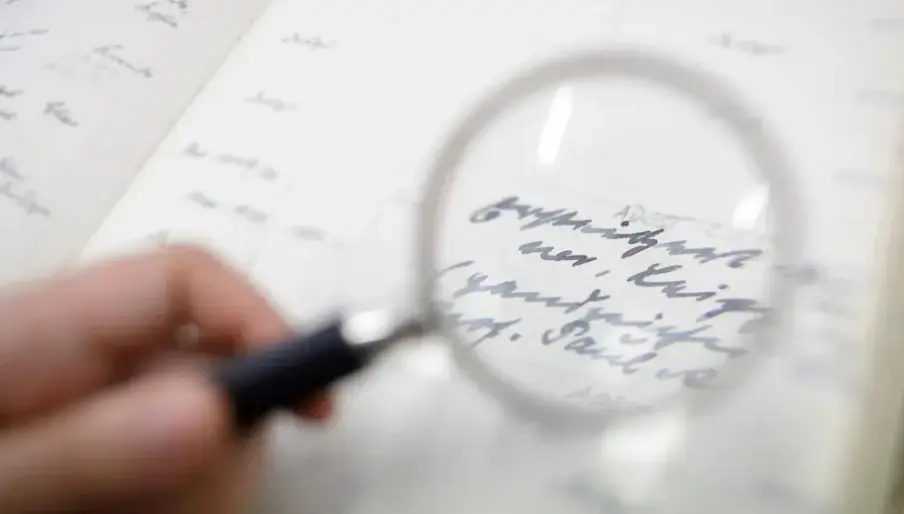
Depending on the case, forensic examination may involve magnification and specialized examination techniques to assess writing characteristics and document features.
The examiner may document:
- Stroke characteristics
- Line quality
- Pen pressure indicators
- Letter formations
- Spacing
- Alignment
- Pen lifts
- Initial and terminal strokes
The objective is to understand how the questioned signature was executed.
3. Collection of Genuine Comparison Samples
Known genuine signatures are essential to a meaningful comparison.
These may include authenticated signatures from:
- Bank records
- Earlier agreements
- Official applications
- Identity documents
- Corporate records
- Employment records
- Correspondence
- Other verified documents
Where possible, comparison material should be sufficiently comparable in terms of date, writing conditions and signature type.
A larger and representative sample can help an examiner understand the writer's natural variation.
4. Comparative Examination
The questioned signature is then compared with the authenticated signatures.
The examiner may assess similarities and differences in:
- Letter construction
- Stroke sequence
- Slant
- Size
- Proportions
- Spacing
- Alignment
- Connecting strokes
- Pen movement
- Initial and ending formations
The significance of each characteristic depends on the circumstances and the consistency of the overall writing pattern.
5. Assessment of Natural Variation
This is one of the most important aspects of forensic handwriting examination.
Two genuine signatures from the same person may not look exactly alike.
An experienced examiner therefore asks:
Are the observed differences consistent with the writer's normal variation?
rather than simply:
Do the signatures look different?
This distinction helps prevent genuine signatures from being incorrectly treated as forgeries.
6. Examination for Signs of Simulation or Tracing
The examination may consider:
- Hesitation
- Unnatural tremor
- Poor fluency
- Blunt starts and stops
- Unusual pen lifts
- Stroke inconsistencies
- Abnormal proportions
- Uncharacteristic movement patterns
These observations must be evaluated collectively.
7. Expert Evaluation and Reporting
- Materials examined
- Examination methodology
- Comparison material
- Significant observations
- Similarities and differences
- Limitations
- Forensic findings
The report should distinguish clearly between observed evidence and the examiner's interpretation.
What Documents Are Needed for Signature Examination?
The quality of an examination depends partly on the comparison material available.
Useful evidence may include:
Questioned Document
The document containing the disputed signature.
Genuine Signature Samples
Authenticated signatures from the person whose signature is being questioned.
Supporting Documentation
Depending on the case, additional documents may provide useful context regarding:
- Date
- Transaction
- Document creation
- Signatory
- Business relationship
Original documents are generally preferable where available because they can preserve information that may not be visible in a scanned copy.
Can a Photocopy or Scanned Signature Be Examined?
A photocopy or digital scan may provide useful information, but examination limitations should be recognized.
Reproduction can affect:
- Line quality
- Stroke detail
- Pressure characteristics
- Ink features
- Fine writing characteristics
- Document-level evidence
Where the original document exists, it should be preserved and provided for examination whenever appropriate.
An examiner should also state any limitations arising from the available material.
Why Visual comparison alone is not Enough
Searching online for “signature matching” may produce automated tools and image-comparison applications.
These can be useful for certain technological applications, but a forensic examination is different.
A forensic examiner considers:
- How was the signature written?
- What writing characteristics are present?
- Are differences within natural variation?
- Are similarities significant?
- Are there indications of simulation or tracing?
- What limitations affect the conclusion?
The context and methodology matter as much as the visual appearance.
Where Is Forensic Signature Examination Used?
Forensics signature analysis can support investigations involving:
Banking and Financial Services
- Cheque disputes
- Loan documentation
- Financial fraud
- Unauthorized transactions
Corporate Investigations
- Contracts
- Authorization documents
- Internal approvals
- Employee-related disputes
Legal Matters
- Agreements
- Property documents
- Wills
- Power of attorney
- Civil disputes
Insurance
- Claims documentation
- Policy records
- Authorization documents
Government and Administrative Records
- Applications
- Certificates
- Official documentation
How to Choose a Forensics Signature Examination Service in India
Before engaging a forensics service provider, organizations should consider:
- Experience in questioned document examination
- Qualifications of the forensic examiner
- Availability of appropriate examination facilities
- Evidence handling procedures
- Documentation and reporting standards
- Confidentiality practices
- Ability to explain findings clearly
- Experience with legal and corporate matters
If the matter may proceed to litigation, organizations should also discuss expert witness or court-related support at the beginning of the engagement.
Forensics Signature Examination in Bangalore
Bangalore is home to a large corporate, financial and technology ecosystem, making document-related disputes relevant across multiple sectors.
Organizations searching for forensics signature examination services in Bangalore, signature forgery investigation in Bangalore, or forensic document examination in Karnataka may require support for corporate disputes, banking matters, contracts, property documentation and fraud investigations.
A local forensic facility can also be useful when original documents require controlled examination and secure handling.
Proaxis Solutions provides forensic examination services for organizations, legal professionals and individuals requiring professional analysis of questioned documents and signatures.
Why Choose Proaxis Solutions?
Proaxis Solutions provides professional Forensics Signature Examination and Questioned Document Examination Services for corporate, legal and investigative requirements.
Our forensic capabilities include:
- Signature comparison
- Signature forgery examination
- Handwriting analysis
- Questioned document examination
- Document authenticity assessment
- Alteration and manipulation examination
- Ink and writing analysis
- Forensic document reporting
- Expert opinion support
Our approach emphasizes structured examination, evidence integrity, confidentiality and clear reporting. For matters involving disputed signatures, original documents and supporting comparison material are assessed carefully before the appropriate examination methodology is determined.
Frequently Asked Questions
What is forensics signature analysis?
Forensic signature analysis is the examination and comparison of a questioned signature with authenticated reference signatures to determine whether the writing characteristics are consistent.
How does a forensics expert detect a forged signature?
An examiner evaluates writing characteristics such as stroke formation, line quality, pen movement, proportions, spacing, pen lifts and natural variation. The characteristics are assessed collectively rather than relying on visual appearance alone.
Can a forensics expert determine whether a signature was traced?
A forensic examination may identify characteristics that are consistent with tracing or other forms of simulation. The available evidence and quality of the original document influence what can be concluded.
How many genuine signatures are needed for comparison?
There is no universal number that applies to every case. The suitability, authenticity, date and representativeness of the comparison signatures are important. A broader sample may help an examiner understand natural variation.
Can a signature look different and still be genuine?
Yes. Genuine signatures naturally vary. Differences must therefore be assessed in the context of the writer's known variation rather than treated as proof of forgery.
Should I send the original document for forensics examination?
Where available and appropriate, the original document is generally preferable because it may contain information that cannot be assessed from a photocopy or scan.
Can forensics signature examination support a legal dispute?
Forensic examination can provide technical findings that may assist legal proceedings. The evidentiary value and admissibility of those findings depend on the facts and applicable legal requirements.
Where can I get forensics signature examination services in Bangalore?
Professional forensic signature examination services are available through specialist forensic providers in Bangalore. When selecting a provider, consider examiner qualifications, evidence handling, examination methodology, reporting and experience with legal or corporate matters.
Conclusion
A signature is more than an image on a document. Its individual characteristics reflect the way a person writes, moves a pen and naturally produces their signature. When a signature is disputed, those characteristics can provide valuable forensic evidence. Forensics signature analysis provides a structured method for examining questioned signatures and distinguishing potential forgery indicators from natural variation.
Whether the matter involves a disputed contract, banking transaction, property document, corporate authorization, cheque, will or suspected fraud, professional examination can help establish what the available evidence supports. For organizations and individuals in Bangalore, Karnataka and across India, choosing an experienced forensic document examination provider is an important part of protecting the integrity of the investigation.
If you have a questioned signature or disputed document, preserve the original evidence and seek professional forensic guidance before making alterations, annotations or unnecessary handling.
Proaxis Solutions provides confidential forensic signature examination, questioned document examination and handwriting analysis services for corporate, legal and investigative requirements in Bangalore and across India.
Contact Proaxis Solutions to discuss your questioned document or signature examination requirements.